

Make your conversations with your children even more meaningful. Connecting communication and values.
Innehåll
- Introduction: How to create Eureka Moments as a parent
- How to understand your purpose and clarify your values
- How to move from a should to could mentality
- What to ask when the kids come home from school
- Openings: Remember when and how you did it
- Ask how, and make a Strength Star
- How to search for strength and potential
- How much is too much?
Del 1 av 8
Introduction: How to create Eureka Moments as a parent
There are happy moments: when your child is born, takes their first steps, says Mommy or Daddy, goes off to nursery school or starts kindergarten. These early milestones mark their growth and development. So too is graduation from high school, getting that first score in a match, or learning a particularly hard skill.
There are surely sad moments, too, from cuts, bruises, or tears that come from hundreds of small or big events from illness to breakups with friends or boyfriends/girlfriends.
Then there are Eureka Moments. A Eureka Moment is that time you see your child figure something out or say something that you never could imagine at that age; they would be able to do or say. Those moments of surprise and insight that come from your child or young adult are your Eurema Moments.
A Eureka Moment is that moment of understanding, awakening, or joy from learning, solving a problem, discovering a new thought, or putting the pieces together to make something work. It could be that unexpected comment that makes you laugh or turn your thoughts upside down.
This course is devoted to how you can create even more Eureka Moments in your relationship with your child or young adult. It’s not about increasing achievement (getting that first soccer goal), receiving that longed-for Christmas present, telling that joke at a gathering of relatives, or showing off their dance steps for your friends.
It’s about deepening your relationship through the art and science of dialog. Yes, this is a short course about talking – having short (or long) meaningful conversations.
How does this course work? The lessons are text-based, with a few short videos. So what can you expect to learn?
– The power of knowing your purpose as a parent
– The importance of your attitude and values
– What questions work, and what questions do not work, for example, when your son or daughter comes home from school
– How even the shortest of conversations can be meaningful, which we call one-foot conversations
– How to ask clarifying questions
– How to look for hidden strengths, talents, and brilliance
– How to follow up in a stubborn but nice way
– How to create a sharing culture in your home
The texts and videos will only take you about two hours to go through. You will receive encouragement, be reminded of important principles for your parenting, gain some practical skills about the art of conversation, and learn to ask questions that lead to a sense of wonder and discovery.
The pain point of all relationships is that feeling of misunderstanding, miscommunication, uncertainty, or, in some cases, that feeling of disconnect or abandonment. Everyone’s life situation is different. If you have enrolled in this course, one thing is true – you are ambitious and really do want to be the best parent you can be. You are willing to learn and challenge yourself.
We live in stressful times with high demands upon our time and energy. A course like this is not a miracle cure. This course is simply a puff forward in your caring and abilities to make a connection, enhance a relationship, and build trust and cooperation. That’s more than plenty!
A word about me, your guide through this Eureka Moments course. My formal background is a Ph.D. in educational psychology. “Empowerment” is my life theme and the core purpose of all I do. I have experience as a school principal, university lecturer, and consultant with an academic background. I am passionate about the hows and whys of education and learning. Good to know is that I grew up in the USA but have lived in Sweden for 50 years. I have three sons and seven grandchildren and am the “father” of 55 books about values, learning, school development, and communication.
I certainly do not have all the answers about parenting, and I certainly have made and continue to make mistakes, but I do have experience! And I do know a lot about the art of a good conversation. So I’ll share what I know and hope it enriches your relationships.
Welcome.
Del 2 av 8
How to understand your purpose and clarify your values
We need to start with your foundation (core philosophy and value system).
Here I will try to make something very complicated a lot less complicated. What is so complicated? Well, you’re not just a parent; you’ve been a child and teenager yourself and have had parents bring you up with their ideas and their methods. Now, that may have been a wonderful experience, or it may very well have been a very traumatic and complex experience.
Maybe one reason for joining this course is to avoid repeating the mistakes you’ve been exposed to or simply wanting to be better at that parenting thing that can be so stressful and easy to get wrong.
You have to know that you are not alone if you think parenting is a challenge. We are not here, however, to delve into your own childhood experiences, traumas, or “baggage.” Instead, we are here to think, search, experiment, and learn.
Your behavior is partly formed from your attitudes, values, or philosophy about parenting. It’s hard to “walk the talk” and connect our values to our behavior, but we all try.
The easiest way to get at your attitudes, values, or philosophy is to make a few lists. (It’s also a good idea to keep a journal.) Don’t spend a lot of time on this; just quickly and spontaneously put 3-5 things on the following lists on the topic of your parenting:
3-5 beliefs about what good parents do well
3-5 things I don’t want to do or do less of as a parent
3-5 things that I want to do or do more of as a parent
3-5 examples of when things turned out well for me as a parent
3-5 examples of things I would like to learn to be better as a parent
3-5 of my fondest memories as a parent
Yes, some answers will be the same, and that’s just fine and emphasizes what’s important to you.
Homework: Summarize your main message to yourself in one sentence after reading over the lists you wrote. It could be in the form of a message or advice to yourself about your parenting. Remember to….
What is your purpose as a parent? Sure, you have to provide the basics – food, safety, security, acceptance, encouragement, and a sense of inclusion.
At the same time, you never know exactly how things will turn out. Some things we know to be true:
Your children will not always think as you do.
Your children will not always do what you do or follow in your footsteps.
Your children will not always value what you value.
Your children will not likely always do what you want them to do or what your think is good for them.
Your children will not always be happy, kind, respectful, or responsible.
Your children will not always be the brightest, most athletic, most musical, or most motivated among their peers. Maybe in a few things, but not in everything.
We certainly wouldn’t mind all this happening, but the likelihood is small, and just maybe it’s not even a good idea to hope for.
In the end, what do most of us want for our children? I am guessing that the overwhelming majority of the people joining this course would want:
Children that take the initiative and have creative ideas
Children that can cooperate with others
Children that can think independently and are not the victims of peer pressure
Children that are curious and motivated to learn and try new things
Children that can talk, discuss and interact constructively at home, school, and with other adults and, of course, their friends
Children that know how to be polite, take responsibility, and put in an honest effort in what they do
Children who understand the importance of helping others and being sensitive to other’s feelings
Children who are not afraid to share their thoughts, feelings, insecurities, and achievements
Children who understand that they can’t always immediately get what they want, but it’s OK to wish, hope, and work for what they want
Please add to this list.
Do we agree with most of the things on this list?
If so, well, how do we get there? One way is through the art of conversation – how we share, ask, discuss and talk about what’s going on in our lives. That is the focus of this course.
My point in this lesson is to suggest that you regularly remind yourself of your purpose and values. Your purpose is to help your children learn, grow, and become responsible and constructive family members and citizens. You nurture and support your child to bring out their strengths, talents, and inner wis
When in conflict, when in confusion, when in frustration, or when in a state of uncertainty, remind yourself of your overall purpose and values. It will help you take a step back, regroup and move forward in your relationship.
Remind yourself about your long-term commitment and purpose as often as possible.
Del 3 av 8
How to move from a should to could mentality
Before we move on to more practical aspects of your conversations, we need to discuss a little bit more about purpose and attitude.
The old-time upbringing was much more straightforward. The child was to obey the adult. The adults decided everything from what to eat to what to think and often even the future occupation of the children. Indeed, children often worked from an early age, and most left school before their teens. Well, we didn’t have “teenagers” until the middle of the 20th century.
My how times have changed, especially as the industrial age progressed and after the anti-democratic movements in Asia and Europe that led to the second world war. Slowly but surely, we became more in tune with what our children thought and wanted.
My parents rarely asked me what I wanted to eat. My mother made the food, and we ate it. However, with three boys in the 70s and early 80s, I found myself suddenly asking them what they wanted for dinner almost daily. It became very complicated. I dieted in one way, my wife in another, the oldest son only “dined” on black Swedish blood pudding (yuk), the next son decided he was a vegetarian, and the youngest, well, he was mostly just confused.
A generation later, I picked up my youngest son’s two kids (before they had twins later that year) at their daycare. That is always an adventure. It was a winter day, and when they came through the door to their home, I reached for the two-year-old’s winter cap and pulled it off as a first step to helping him off with his winter jacket and pants. His four-year-old sister stops me and tells me that I have to ask her brother first if it’s OK to take off his cap.
What??!! I took off the cap anyway, but big sister was not pleased. Later, as I made dinner for them, I set the table, and before I am to serve the youngest, he told me he doesn’t want that plate. He points and says No. So I change it for another. Again, No. I change it for a third. No. I take out the first one again. OK, that was alright. He simply wanted to be in on the decision-making – at the age of 2 ½.
What the heck is going on here? Reading between the lines, I am sure you can tell that I am a “softie” and have never been a tough, rigid, or authoritarian type, with my “be nice” humanistic values. I have to admit, however, that I was more than flabbergasted. As an educational psychologist studying the art of leadership in the classroom, I know there need to be norms, rules, consequences, boundaries, and routines.
How bringing up kids has changed – not for all, but for many parents – in this era of involvement, democracy, and respect for individuality.
What to do? How do you find the right balance between the adult setting the rules and norms and the children having their say? But, of course, the adult has to set the rules, you say, and I counter and say, well, yes, but all the rules? Which rules? At what age can the child contribute to the rules or have a say in family routines?
Suddenly it is a bit complicated, much like any democracy. Democracies are messy, and so is family life sometimes.
One way of looking at the changes in attitudes towards bringing up children and building a positive relationship with teenagers and young adults is to see the difference between what we can call “should” upbringing and “could” upbringing.
“Should” upbringing is the old pattern of telling, regulating, controlling, and sometimes shaming, threatening, or punishing. You should do this. You should do that. We always do it this way. Here’s what you have to do. These are the rules, and there is nothing you can do about it. If you don’t do that, then…
“Could” upbringing is more based on the idea of finding strengths, talents, and potential. What could you do? What are the alternatives? What is your thinking? What are the advantages and disadvantages? What skills are involved? How can you be more of what you can be? Where are you going with this?
This is not a course on upbringing, so I shall spare you a detailed discussion about upbringing ideology or methods through the generations. I am simply saying that modern upbringing has moved from “telling” to “communicating,” and communicating means respecting, sharing, discussing, and the give and take we assume happens if we believe in democratic ideals, even for children. When you use communication instead of telling, you need to understand that the result may be a whole lot different from what you had hoped for, planned for, or expected. However, you may be bringing up a “constructive, active citizen and contributor” in the long run. That’s not bad, but it may take its toll on everyday life! Yes, democracy and communication can be messy and still be extremely precious in the big picture of life’s and society’s potential. The methods I will soon describe in this course are built on the “could” concept and the “communicating” concept. You need to understand that to be open to my approach here.
This approach has many of the following underlying assumptions:
Each child is unique.
Each child has strengths.
Each child has individual rights.
Each child has opinions that need to be respected and heard, if not always followed.
Each child can take responsibility when cooperation is a family norm.
Each child can learn.
Each child will develop their own patterns of likes and dislikes.
Each child will grow within an atmosphere of acceptance and warmth.
A “could” mentality instead of a “should” mentality stands for your ability to communicate, see potential, encourage and accept the uniqueness of each child.
Now, get me right – this does not mean that everything has to be negotiated. If you recall some of your best teachers or bosses, you’ll most likely see that they had a good balance between their hard side and soft side. Too hard, and people become resentful. Too soft, and very often, nothing gets done with a lot of talk and no action.
It’s the same as a parent for these new generations of kids who expect to have their say. Too hard, restrictive, or authoritarian does not breed loyalty and willing cooperation. Too soft, and the norms, rules, routines, and roles become uncertain.
The balance is tricky.
Let us explore one way to make this shift from should to could and the balance between hard and soft – through the art of a good conversation.
Homework: Write three examples of should. This is a list of non-negotiable norms for your family life. For example, about the use of foul language, norms for family dinners, or routines that you absolutely want to stick to. To function effectively, every household (classroom or organization) needs a few clear non-negotiable statements of expected behavior.
Write three examples of could. One approach is to think of three things you could do more of together with your children. Would it be more play? More outdoor time? More time to talk before bedtime? What are at least three examples?
What would it take to communicate more clearly your three non-negotiable norms? If you were to do more of one of the things on your list, how can you make that happen this week?
Del 4 av 8
What to ask when the kids come home from school
We start exploring specifics with a classic – what to say or ask when the kids come home from school. I think everyone reading this will recognize the situation. You are curious. You really do care. You want to reach out to your son or daughter. You want to build an even more constructive relationship. You want to start a meaningful conversation and exchange of ideas and experiences.
So what do you say or ask? Recognize these examples?
– So how was school today?
– Anything special happen at school today?
– So what did you do at school today?
– What did you learn at school today?
– Everything OK today?
– What’s up? (What’s new?)
– Tell me about your day.
I think you will also recognize these responses:
– Fine
– No
– Nothing special.
– Don’t remember.
– Yeah, everything’s OK.
– Nothing
– Another time. Gotta go.
Well, what did you expect? Maybe…
– Today, we had an intense discussion in Mrs. Lambert’s class about the differences between the French and American revolutions. Did you know that….
– Today, we started a new project, and Mr. Jorgenson organized the groups in a really funny, surprising, happenstance way. Want me to tell you about it?
– One of the most interesting things we did at school today was to go on a Peace Walk with someone in the class we usually don’t talk to. We had three questions to ask each other. It was fun to get to know another person a bit more. Want to know the questions?
Yeah, sure….I say sarcastically. Do those types of responses happen regularly? If so, congratulations! Really!
Let’s face it, those types of responses are rare. So let’s approach this in another way. Lower your expectations. If you get into a good give-and-take conversation, that’s great, but even a very brief, ten-second interchange has its value, and I think you should be very pleased if your child or young adult gives any detail whatsoever about what happened at school that day.
Specific in-specific out
How can you make that happen?
One of the best rules of good communication is “specific in-specific out.” You’ve heard of the computer programming rule that says junk in-junk out. It only takes one 1 or 0 mistake, and the program will not work correctly, so you have to be very careful entering your code.
It’s the same thing in a conversation. Ask a general question; you will get a general response. That could be OK, but you have to ask something specific if you want more.
You can surely start with some general questions, but let these questions have a bit more “character” What I mean is that, “How’d it go today?” could be replaced by “What’s the most interesting thing that happened today?” That’s still a bit general. Will that get you a Eureka response? No, surely not. Eureka doesn’t happen very often, but you are gaining a couple of things here:
– You are showing interest.
– You are showing that you care.
– You are showing curiosity, assuming you don’t ask with body language that says you don’t have time to listen.
– You are giving an opening.
This last point is important. Don’t always expect or even go for detailed responses. Be happy if they just look up at you or out into space to think about your questions. Yes, they may think you are overbearing, and you do not want to dig and delve or demand a response. Instead, you are simply giving them something to think about and, again, providing an important opening.
Other examples where specific may lead to specifics:
– “Anything special happen in Mr. Jorgenson’s class?” is much better than, “How was school today?”
– “What was one example of a question that was on the test today?” is much better than “How’d it go on the test?”
– “Who were you with at recess?” is better than “Did you have fun today?”
– “What is one question you are sure will be on the test on Tuesday?” is better than, “What do you have to do to get a good grade on the test on Tuesday?”
– “What is your job in that new group project?” is better than, “How are things going on that new project?
You still may not get a detailed response. These questions may still might not lead to any deeper conversation. That’s perfectly fine. You are giving an opening that helps your son or daughter get to a more specific answer, but you won’t always get a detailed answer.
Remember your long-term goal – enhancing relationships and a sense of trust. Give lots of openings without expectations of responses. Asking more specific questions increases the likelihood of better responses, but not always. You demonstrate your caring and curiosity, and that’s the main point.
There are other opportunities in other situations, of course, not just after school.
– After sports practice
– After a trip
– After a party
– After meeting friends
– After watching a show or movie
– After playing a computer game
Or just a follow-up to the general question of “How you doing?”
Homework: Now it’s time to practice. Tell a friend or your partner what you asked differently today and tell them how it went. Just don’t expect miracles. Remember, you are investing in your relationship, so don’t overwhelm; just create an opening. What are examples of “specific” opening phrases or questions you used this week?
Del 5 av 8
Openings: Remember when and how you did it
“Remember when….” is a good conversation starter. Think about your best friend or your life partner. With your life partner, wouldn’t it be good to reminisce about when…
– You first met
– You had your first date or your favorite date
– The last time you had a big laugh together
– The first big trip you did together
– The best gift you ever gave each other
– You discovered something later on that you never knew about each other
– You got through an upsetting or sorrowful time
– You solved a big problem by helping each other
– You organized that party or outing that worked out well
– We had great fun with the kids
This is also a good activity to do with your children every now and then. Remember when….
– We went on that special trip
– We went to that special restaurant
– We laughed so hard when we watched that movie
– We got lost
– We got so mad at each other, screamed and fought
– We saw X (a famous person)
– We went to that high-scoring game
– We were bored to tears and couldn’t decide on anything to do
– We celebrated X
This lesson explains that you don’t have to ask many questions and that opening, reflective questions are just fine, even if the conversation is only for ten-twenty seconds.
Here’s the basic theory behind this approach to coaching conversations.
We know we want our children to become constructive citizens, independent and responsible, with a positive state of mind.
There are dozens of issues where conflicts and uncertainty can arise: religion, politics, career choices, school, money, sex, love, alcohol or drugs, behavior on social media, information and disinformation, peer pressure, personal taste, hobbies, habits, relationships with friends, family, crushes, physical health, psychological health, etc.
To deal with all these issues, sometimes even the youngest children need to think through their thoughts and clarify their attitudes, values, feelings, or behaviors. Confusion can lead to indifference, running from one thing to the next without direction, constant changes in values or conduct, giving in to peer pressure, seeking approval from destructive friends or groups, acting out, etc.
We know, deep down, that moralizing for our children rarely works. Sometimes it drives them away or in the opposite direction. Not engaging and just sitting back and hoping things will resolve themselves may work once in a while, but usually is not a good strategy. We can be good role models, but these days parents are hardly the only models children see in action.
What to do? Of course, no approach will solve everything, but short coaching conversations can help.
When you engage in conversation and ask reflective questions, you are helping your child or young adult think about alternatives, advantages, and disadvantages as they examine their attitudes and behaviors. You are helping them clarify their options, decisions, and actions and thus helping them to clarify their thoughts.
The hypothesis is that if you often ask reflective clarifying questions, your son or daughter will, sooner or later, ask these questions of themselves and thus be a bit more prepared to deal with life’s conflicts, uncertainties, and choices.
There are no guarantees, and you shouldn’t overdo it by being a question machine, but the basic premise is that a young person will benefit by engaging with adults who care and are curious.
Let’s take a silly little example. You hear your child say it’s nice weather outside. You can ignore it, tell her it’s going to rain later in the day, disagree, or simply say agree and say, Yes, it’s nice. But you can also simply ask, what are you going to do today when the weather is so nice?
To answer that question, your son or daughter has to sort through alternatives, think about things she likes to do, and choose and verbalize an answer. That is a valuable process.
Examples of reflective questions useful in many situations:
– Where did you get that idea from?
– Have you been thinking about this for a long time?
– What are the alternatives?
– What are the advantages or disadvantages?
– What attracts you to this idea?
– Where did you get your information – or what information do you need to decide?
– What are the possible consequences or outcomes?
– Do you mean that….?
– Are you choosing this for yourself or because of others?
– Do you think other people should also make that choice (or think that way)?
– Tell me more about your thinking.
– Are you willing to stand up for your opinion or choice?
– Is this something you want to do more often?
– How are you going to put this into action?
– What do you need to do to get to the next step?
– Who has influenced your decision?
– Are you willing to invest even more time in this?
Please, please don’t ask all these questions at once. The last thing you want to do is be a nag or turn this into some kind of interrogation.
These types of questions sometimes will even turn into Eureka Moments because you ask others to think, examine, see patterns, and understand choices. That may lead to new thoughts and surprises, patterns, or simple confirmations of previous choices.
You are increasing the likelihood of self-awareness and reflective choice-making. That’s pretty darn good if you ask me.
One major warning. Don’t ask reflective questions with the purpose of having your children (or spouse) agree with you or do as you desire. The long-term goal is independent, critical, reflective thinking and action, not just coming to the same conclusion as the adults.
Be careful out there…. If you have decided in advance what your son or daughter should do or think, the questions won’t work. On the other hand, if you have decided to help your son or daughter think about the could, your relationship will become even more respectful and fruitful.
Homework: Look at a choice you have made this week that has consequences for your personal life or work life. It could be about food or physical activity. It could have to do with a friend or family member. It could be a decision about priorities for your time at work or your relationship with your boss or a colleague. Write down three examples of reflective questions you could ask yourself about your decision. For example: What are the advantages or disadvantages of various decisions or what alternatives exist or what is needed for your next step?
Just maybe you will come up with an answer that will surprise you, confirm something for you, and provide a reason to rethink your decision. This process you are testing on yourself is valuable to do with your children every once in a while. In the long run, you are part of that adventure to raise thoughtful, self-aware children.
Del 6 av 8
Ask how, and make a Strength Star
During my training in psychology, psychotherapy, and education, I was told not to ask the Why question. I still don’t understand why not. Trying to understand another person’s purpose, values, or thoughts is an extremely valuable quest. I assume we were told not to ask that question because it’s just plain hard to answer. There are other ways to get at purpose, values, and thoughts.
I use the why question now and again. But I rather recently discovered the power of How. It was a true Eureka moment for me when I participated in a five-hour “event” with one of the world’s most renowned personal growth coaches. He would lecture and then, once in a while, go out in the crowd (and it indeed was a crowd!) and talk to individual participants and conduct a mini-coaching session.
All of a sudden, the light goes on in my head. He is asking How instead of What or Why questions. I nearly jumped out of my chair and screamed. Finally, after thirty years of searching, I had discovered a shortcut to successful brief-time coaching. It made so much sense, and I immediately became aware of how I could make my conversations and coaching much clearer, to the point, specific and valuable.
One would think that it’s just fine to ask What questions, and usually, it is enough to have a good conversation.
– What do you enjoy doing?
– What are you good at?
– What would you like to do now?
– What would you like to do more often?
– What’s happening in your life?
– What’s your next step?
– What do you need to do?
– What’s your top priority right now?
– What are you thinking? How are you feeling?
– What choices do you have?
It’s OK to ask these questions. The problem is that the What question most often leads to generalities, not specifics. Connecting values to specifics is the driving force of personal growth and organizational development.
What would you like to do? What do you enjoy doing? Maybe the reply is that I really like listening to music, watching funny videos, playing computer games, training soccer techniques, being with friends, etc. Fine. You can have a brief and rewarding short conversation about what they enjoy doing and ask a few more questions just to understand a bit more about what they get out of it.
“I love that computer game X.” Tell me about how that game is set up. Nothing wrong with that exchange. If, however, you were to ask them how they figured out to get to the next level in the game, they would have to examine their strategies and decision-making. It leads to another level of self-awareness and self-analysis that can be very valuable to enhance in the long term.
“How was the game?” “We won. I had an assist.” “Great! Did you have fun?” “Yeah, feels good to win, right?” All is fine and well. I am just saying that asking about How they made that assist, How they “saw” that opening, and How they made the decision to pass the ball leads to a whole different set of self-reflection. And if they can’t immediately answer, that’s OK to. You are setting the table for later How conversation.
“Thanks for being so nice to Aunt Liza today. I saw you made her smile. How did you do that?”
“You say you finally figured out got your workgroup to finish on time. What was your contribution, and how did you get everyone in the group to finish their part?”
“Thanks for getting your brothers to stop fighting. Tell me how you did that. I’d like to learn!”
“I appreciate the time and effort you put into your learning to play the guitar (violin, game, or whatever). But, how do you get yourself to practice even when you are tired or don’t want to practice?”
Let’s make this visual with the help of what I call a Strength Star.
Here you see a five-pointed start with What on the outside and How on the inside. If you ask your child (friend, colleague, etc.) if you can do a Strength Star with them, ask them the What questions first. “Let’s write up things you enjoy doing or think you are good at doing on the outside of this star.
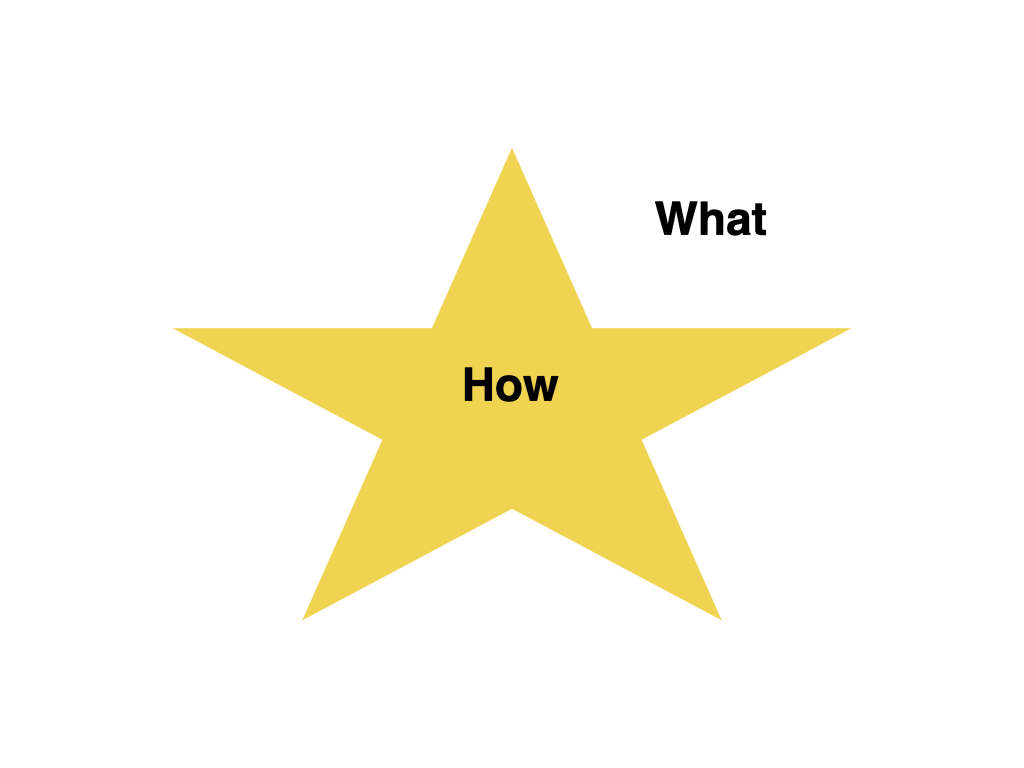
You hear special energy about one of the points. The example below is with a 12-year-old girl. She likes doing several things, but you sense that “dogs” seems to be a little more special than the other things around the star. So you choose to talk more about her interest in dogs and she tells you that she goes out with the neighbor’s dog, who can be pretty aggressive every once in a while.
You ask the “How” question. So, How do you manage the dog when it gets aggressive? And the girl says, “Well, I need patience, that’s for sure, and I try to talk calmly. But I’m stubborn too, so I can wait until he calms down.”
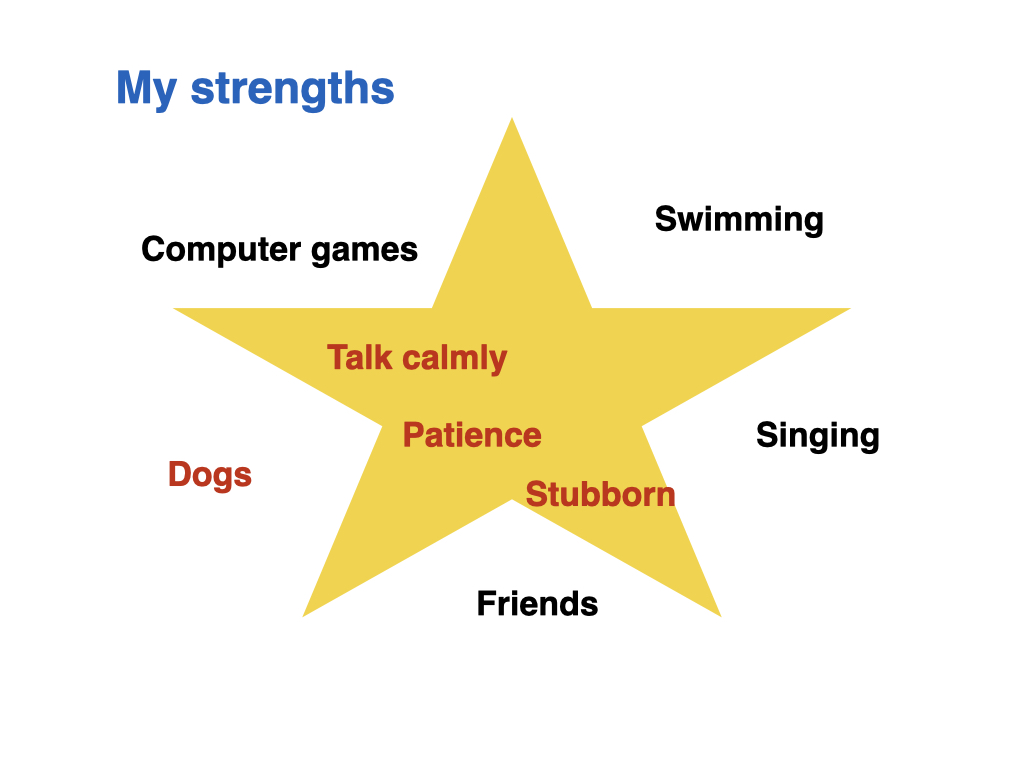
Dogs – that is one of her interests and activities
How she manages an aggressive dog – is her challenge
The details of How she does the managing – is her strategy
The traits or methods she uses (patience, talking calmly, being stubborn) are her strengths.
These strengths, you can point out, can be used in many other situations. And you may ask about that – or just talk about walking that dog. So you don’t always need to press forward in your conversation.
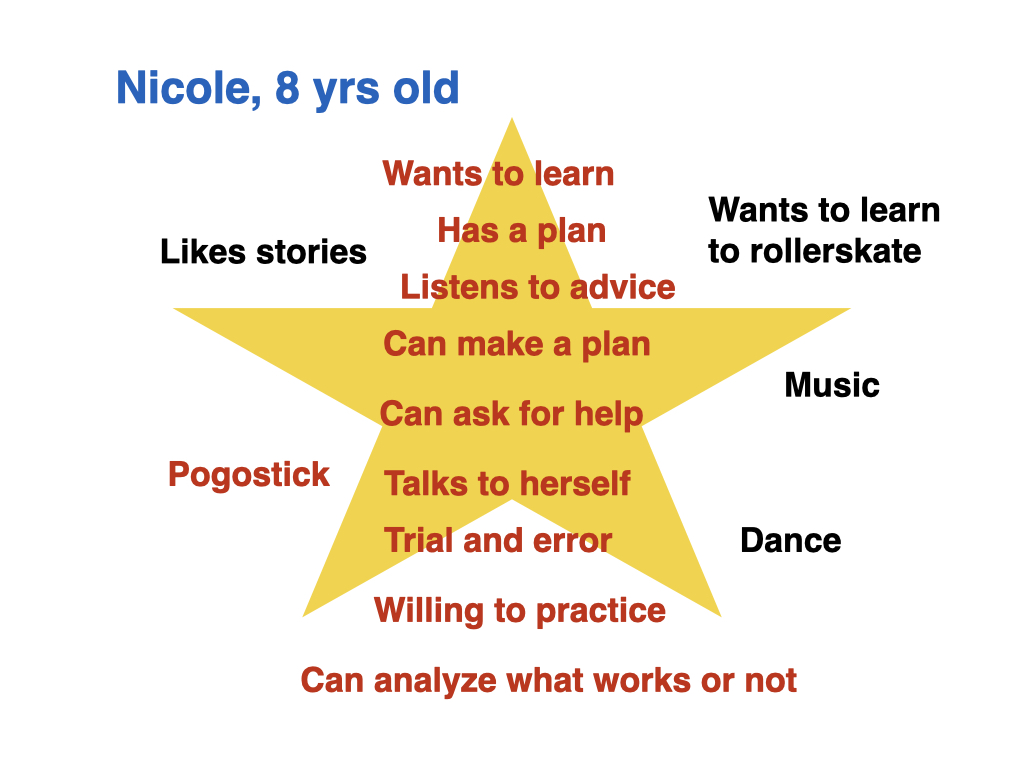
This is what Nicole’s Strength Star looked like (A brief story of Nicole is in the next to last film in the course after the Soccer story). The start describes her learning process, which is quite remarkable for an eight-year-old:
One could also make it with drawings they make or cut-outs from magazines, clipart of photos on the net. Here’s a strength star for a nine-year old:
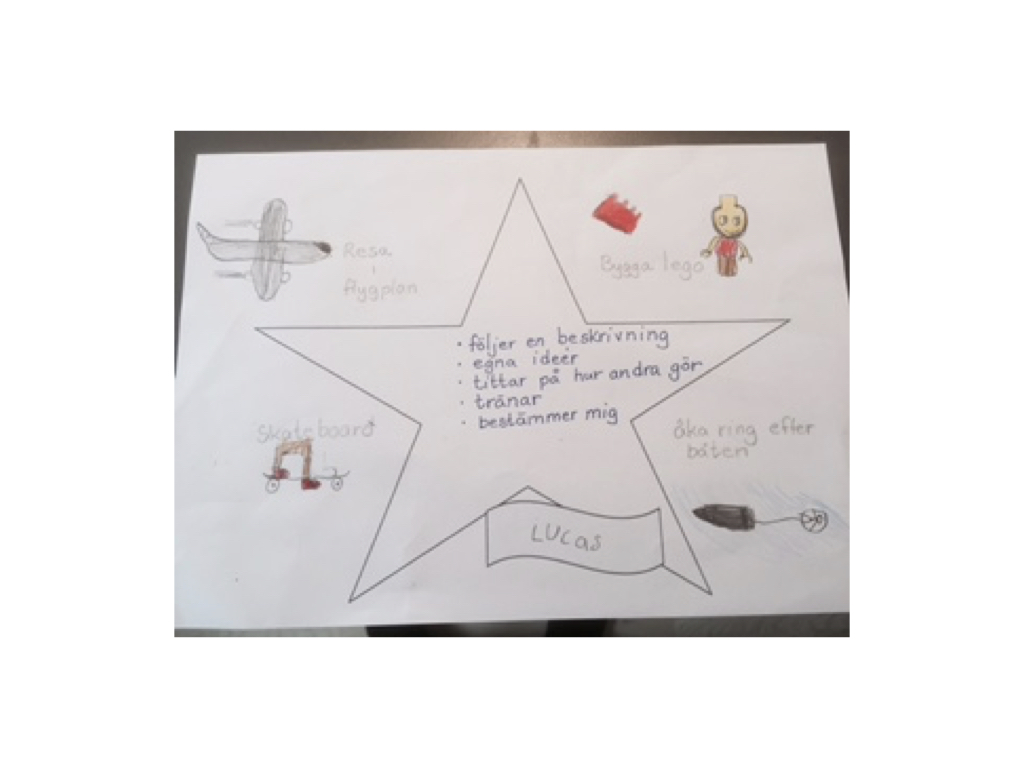
Obviously, you have to judge the situation at hand and if your talking partner is willing to do a Strength Star. There is nothing wrong with a short conversation about walking the neighbor’s dog. I simply mean that making it visual sends the message about strengths, methods, and personality traits much more clearly and has a greater long-term impact.
“Thanks for telling me how you do X. It was fun to know more about how you go about X. It sure is useful sometimes to be patient and talk calmly (or whatever the keywords are that you hear), and nice to hear you have those skills.”
Discovering How can turn into a very rewarding Eureka Moment. Eureka Moments are the results of your connection, questions, and caring. I remind you not to pressure your son or daughter to answer or dig deeper. Instead, you provide an opportunity to explore their thinking and need to be sensitive to when to leave it be and when to ask a little more.
Homework! Do a Strength Star for yourself about yourself. Then try it out with a good friend. Later, try it with a son or daughter. In another course for teachers, this method will reappear because it can be an extremely valuable tool for teachers in making strengths visible to students and parents.
Del 7 av 8
How to search for strength and potential
One of the joys of parenting is seeing or hearing your child do or say the unexpected, especially when that unexpected is something helpful, kind, or thought through.
Without any prodding or asking, I saw my seven-year-old grandchild empty the dishwasher and put the dishes away when I was at her house babysitting the other day. My jaw dropped, and I looked on in amazement and, of course, said a few words of appreciation. I waited until she was done so as not to interrupt. I was surprised. Geez, I still remember the day my oldest son, then around twenty, took out the garbage without being asked. (I am the” might as well do it myself” type of parent/grandparent – certainly, that is not always good, but that’s my personality. Just do it.)
What is a strength? A strength is a characteristic or skill that helps an individual solve a problem or move forward. Strengths can come in many forms and sizes.
Let me ask you a simple question. What did you say to yourself this morning when you looked in the mirror for the first time, like when you brushed your teeth? Was it, “Wow, great to see you today. You’re going to have a great day” or was it, “Boy, you look tired and stressed out.”? And then you put yourself on the scale, and that may not be a very uplifting experience. I am guessing that the majority probably say something more negative than positive to themselves. We seem to be very good at criticizing ourselves and others. It comes naturally!
It follows us our whole lives. Most parents seem to have more negative commentary in dialogues with their children than positive commentary. Do you do that with your partner as well? Don’t! You went to school and had teachers that emphasized your weaknesses and mistakes.
It can be difficult to break that pattern. Surely, we need to be aware of our weaknesses, and we need a high dose of self-awareness, but just perhaps there is a lot more to gain by focusing on our strengths instead of our weaknesses.
Children need to feel safe, secure, comfortable, accepted and loved. Imagine being brought up in a home without that. Unfortunately, that happens too often, and some people never recover. “But you have to point out faults, have to correct behavior, have to make them change….” Well, sure, once in a while, but if this is the normal pattern, kids will lose their self-confidence and sense of security.
I must say that the paradigm of parenting and teaching is built upon the paradigm of correcting weaknesses. I am suggesting that you explore the paradigm of encouragement and strength finding. This does not mean never pushing back, pointing out other ways to act, or saying that some behavior is unacceptable. This is necessary because you need functioning routines, norms, rules, and consequences in order for your family to work.
I am just saying building what works and actively hunting for strengths is a better long-term strategy.
To my granddaughter, I could add a phrase or two after thanking her for helping empty the dishwasher. “You can be very helpful. I appreciate that. You seem to get a kick out of putting things in order.” I am simply confirming and affirming her efforts, but “helpful” and “order” are also words of strength.
Your son or daughter opens the door for you. “Oh, thanks for opening the door. That was very polite and helpful.” You are pointing out that you appreciate the help and appreciate politeness and implying that they have those traits.
Your son breaks up a fight between his two younger siblings, and you say, “Phew. Thanks for the help.” You are pointing out that you appreciate the help and rely on them to help out now and again, a much-appreciated trait.
Your daughter works hard on a homework task. You see how hard she tries, and you simply compliment her and say that you see how hard she is trying. “I see that you are giving it your best.” Perseverance and following through are enormously important strengths.
“Nice how you got Aunt Liza to laugh. Making other people comfortable or happy is a nice skill to have.”
You are observing what works.
You are positively reinforcing what works.
You are making what you value as a parent known without pointing fingers.
You are showing your appreciation.
You are finding words for their strengths.
You are giving encouragement.
That’s quite a lot you have accomplished with a three-second act of strength finding and encouragement.
One word of warning. Don’t turn this against them. “Remember when you were so nice to Aunt Liza? So why are you so mean to your little sister now?” It’s like the teacher that says, “You are so focused when you play ball, but why can’t you focus on your math?”
The last thing you want to do is use their strength against them. Just point out and promote strengths, and slowly but surely, this encouragement will positively impact their behavior. Just remember, this is not that famous Course of Miracles. This is a course on the art of a rewarding, reflective conversation. You find the small bits of a large puzzle and put them slowly but surely in place.
Maybe! Be comfortable with maybe. You are in the parenting business, and there are no guarantees, just small things you can do to provide a warm, accepting home that, through behavior and conversations, leads to responsibility and constructive give and take.
Homework: Be a strengthfinder. That is your homework. Find two or three examples in each family member when exhibiting strengths. Actively look for strengths. Share what you saw and heard, and add a word of appreciation. You may be pleasantly surprised. Your son or daughter (or partner) may be surprised, too at your new sense of appreciation.
Remember that non-traditional strengths are just as important as traditional strengths.

Del 8 av 8
How much is too much?
There have been several warnings in this course about asking too many questions and trying to dig too deep. Getting the right balance is tricky. See this as a sort of continuum where not saying anything or not getting involved at all is on one side and overbearingly being controlling or analyzing is on the other side.
Where are you on that upbringing continuum? Let me give some personal examples. I have never been the type that forces myself on other people. For example, with my children and now my grandchildren, I might sit on the floor near that pile of Legos and start fiddling with them. The kids would be curious and choose to come to me. I rarely went on the offense and said, “Let’s play with Legos.” I would also often let the kids choose between two or three alternatives.
I am not saying that this is the best approach; I am just saying this is how I am as a person. I enjoy empowering others, encouraging others, letting others explain their ideas, and giving others space to explore. Sure, I like to be in the center of things – but I am more of the introvert type and have to recognize that and appreciate that part of me. On stage, I turn into a whole other type of human, but that’s another story. I can be shy with other people and kids and grandkids, I like to provide an accepting atmosphere and see if they want to come to me.
You may be different from me and approach your kids or grandkids differently than me and be more on the offensive. I am just saying that the two extremes on this continuum are poorer strategies than having a good sense of balance. Too little or too much are neither the best ways to go about building relationships and trust.
Earlier I mentioned the important principle of “specific in- specific out”. This applies especially to the art of follow-up. So here’s a story to explain: I am teaching a group of pre-school teachers about the importance of verbalizing appreciation and the connection between behavior and the need to encourage values such as politeness and respect.
I teach teachers to focus on behavior instead of generalizations about being kind or polite or a good friend. When a child opens a door for you, I give the example that you tell them how much you appreciate that. “Thanks for opening the door for me” – and connect to a value word – “It’s very polite of you to open the door for me.” The key is linking behavior with values.
One of the pre-school teachers in the group says, “Well, John, there is a third thing to do. When you see the child the next day, say something like, “Last night when I got home, I was thinking about how polite you were yesterday when you opened the door for me.” Of course, I thought. It’s a good idea to remind, confirm and affirm the child’s positive act of kindness and politeness.
That is a good example of a follow-up, and I have often shared that story that adds an important element to my message.
The three steps:
- Thank the other person and show appreciation for what they did or are doing
- Link the behavior to a value-laden word.
- Later remind them of what they did, how it affected you, and the value-laden word.
It is often a good idea to end a conversation with a query about their next step whenever possible. Try to end on a specific and not a generalization.
You’ve been asking about their game and how it went. You’ve asked a reflective question such as how were you able to make that important pass to a teammate. You could end by asking about one thing they could practice more often that might lead to still more assists.
“Wow, nice how you got Aunt Lizy to smile. Nice to see how your way of talking to her helped her relax and feel good. Anybody else you can think of whom you’d like to get smiling?” Maybe they have an answer, maybe not, but you get them thinking of other possibilities to use their “get other people to smile” skill.
Thanks for getting your brothers to do something else other than fighting. You seem to have a knack for finding practical solutions. Any suggestions for something more we need to do to have a more pleasant atmosphere at home?”
Yes, I know. Easier said than done. Or you may think I sound like up in the clouds academic. I get it. Reality does not always lend itself to simple solutions.
But as an academic, I say – yes, but think of the principle behind this!
Short follow-ups give a message you seriously care about what’s going on and what future possibilities could be.
A few final words of advice.
Be always on the lookout for:
Strengths – personal characteristics that help a person succeed
Skills – abilities that help a person solve a problem and move forward, sometimes intuitive and sometimes gained through practice
Talents – A talent can be obvious and “traditional,” such as musicality, athletic ability, social competence, and short-term memory skills that help with schooling. A traditional talent that often is recognized at school and at home. However, a talent can also be non-traditional, like getting people to relax or smile, connecting people, or finding information or people who can help. There are no grades for “getting other people to feel welcomed or comfortable.” Hunt for both sorts of talents, traditional and non-traditional.
Values – Values are related to statements of purpose, beliefs, and strong opinions that can drive a person’s behavior.
Constructive behavior – acts of cooperation, kindness, politeness, or empathy that you appreciate and can acknowledge
Passion – a deep interest in a subject, activity, event, or the like which indicates something they enjoy, want to know more about, or spend more time on
Flow – when a person loses him or herself in an activity, time flies by which almost always leads to a feeling of satisfaction.
Eureka moments – Yes, look for those Eureka moments when new insights, thoughts, and plans take form. You will find it not only by what others say but also by how they react with wider eyes, often looking up and a facial expression of pleasure.
A word about praise: We often praise our children for their achievements. Let me suggest you praise them for their effort and show appreciation for their thoughts and thoughtfulness. You show appreciation for them as a person in that way, not just their achievements or successes.
Be observant. Express your sense of wonder or appreciation. Acknowledge and…. now and then ask a question to encourage reflection.
You will be rewarded with a greater sense of connection, trust, and cooperation. Your daughter or son will be rewarded with the ability to ask themselves crucial thought questions that will help them deal with life’s various array of choices and steps forward.
Here’s hoping the ideas in this course lead to more Eureka Moments for you as a parent and help even the people around you to make new discoveries about themselves, their thinking, and their behavior.
Homework: Like any good teacher or mentor, I ask you to summarize your three most important learnings from this course. Share them with others.
Have many Happy Eureka Moments in your parenting.
John